
Why Smart Glasses Fashion OEM Is the Next Big Opportunity
A smart glasses fashion OEM partnership is the fastest route for eyewear and lifestyle brands to enter the wearable technology market. The global smart glasses market was valued at USD 878.8 million in 2024 and is projected to reach USD 4,129.3 million by 2030, at a 29.4% CAGR, according to MarketsandMarkets. For fashion brands, this surge signals a fundamental shift in how consumers think about eyewear.
Every smart glasses fashion OEM partnership lets brands enter this market without building electronics capabilities from scratch. Instead of investing millions in R&D, brands leverage an experienced smart glasses OEM manufacturer to handle hardware design, firmware, and production. A smart glasses OEM manufacturer with fashion sensibility bridges the gap between consumer electronics engineering and the aesthetic standards that eyewear buyers expect.
Fashion Meets Technology: The New Eyewear Category
Unlike industrial AR headsets, fashion smart glasses must meet the same aesthetic standards as luxury eyewear while delivering wireless connectivity, audio, camera, and AI features. This dual requirement makes the smart glasses fashion collaboration demanding and rewarding. AI smart glasses bulk order volumes are rising as brands recognize that first-mover advantage translates to shelf space and customer loyalty. The fashion eyewear OEM collaboration model enables brands to merge design DNA with cutting-edge wearable technology.
Smart Glasses Design Collaboration Process Explained
The smart glasses design collaboration process typically spans 3–6 months from concept to production-ready samples. A structured smart glasses design collaboration process ensures both the brand’s visual identity and the technical constraints of housing electronics in a frame form factor are addressed simultaneously.
From Concept to Prototype: AI Glasses ODM Design Collaboration
The smart glasses design collaboration process begins with a detailed brief covering target audience, desired features, price point, and aesthetic direction. A capable AI glasses ODM design collaboration partner translates this brief into industrial design concepts. Key deliverables include 3D-rendered frame concepts, component layout plans for speaker, battery, PCB, and camera placement, and material recommendations based on weight and durability targets.
A successful smart glasses fashion OEM collaboration aligns on these deliverables before moving to engineering. Skipping alignment is the most common cause of costly redesign cycles.
Smart Glasses DFM Review: Balancing Style and Electronics
Once industrial design is approved, the smart glasses OEM manufacturer conducts a smart glasses DFM review — a systematic assessment of whether the design can be manufactured reliably at scale. A thorough smart glasses DFM review examines weight distribution (target under 40 g), thermal management, antenna placement, lens mounting for prescription compatibility, and IP rating feasibility.
This smart glasses DFM review step is critical for fashion brands, because a beautiful frame that fails drop tests or cannot accommodate required electronics will never reach production.
Prescription-Ready Smart Glasses Manufacturing
Prescription-ready smart glasses manufacturing ensures the frame accepts custom Rx inserts without compromising electronics housing. This requires precise lens groove specifications, removable nose pad options, and temple designs that accommodate thicker lens edges. A fashion smart glasses private label program that includes Rx compatibility captures a much larger customer base than one limited to non-prescription wearers.
Smart Eyewear Bulk Manufacturing: What You Need to Know
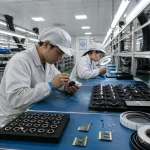
Transitioning from approved samples to smart eyewear bulk manufacturing involves component sourcing, production line setup, quality control protocols, and logistics planning. Smart eyewear bulk manufacturing at scale demands a smart eyewear OEM supplier with integrated SMT and assembly capabilities.
Lightweight Smart Glasses OEM: Materials and Weight Targets
Weight is the single most important physical attribute of a smart glasses product. A lightweight smart glasses OEM partner works with TR90 nylon, carbon fiber composites, and titanium alloys to keep total weight under 40 g for standard models. Frame material choices also affect durability, allergen safety, and perceived quality — a lightweight smart glasses OEM approach must balance all three.
Smart Glasses Private Mold Development
For brands wanting a unique frame shape, smart glasses private mold development is necessary. This involves designing custom injection molds for temple, front, and nose bridge components. Private molds typically cost USD 5,000–15,000 per frame component with 30–45 day lead times. A custom smart glasses manufacturer can advise whether private mold development is justified by your volume plans, or whether semi-custom programs using existing platforms are more cost-effective.
Smart Glasses Mass Production Guide
A typical smart glasses mass production guide timeline:
| Phase | Duration | Key Activities |
|---|---|---|
| Pre-production samples | 2–3 weeks | Fit, function, and finish validation |
| Component procurement | 3–4 weeks | SoC, battery, speaker, camera sourcing |
| Mass production | 30–45 days | Injection molding, SMT, assembly |
| QC and packaging | 5–7 days | Testing, inspection, packing |
| Shipping | 15–30 days | Sea freight or 5–7 days by air |
Total smart eyewear bulk manufacturing lead time from order confirmation to delivery is typically 75–100 days. Any smart glasses OEM manufacturer worth partnering with will build buffer time for certification testing into this schedule.
Bulk Smart Glasses Manufacturing Cost Breakdown
Understanding the bulk smart glasses manufacturing cost breakdown helps fashion brands set realistic retail prices. Costs vary based on feature set, component quality, and order volume.
Unit Cost Tiers by Volume
| Feature Set | 50–99 Units | 100–499 Units | 500+ Units |
|---|---|---|---|
| Bluetooth audio only | $28–$38 | $20–$28 | $15–$20 |
| Audio + camera (5–8 MP) | $45–$60 | $35–$45 | $28–$35 |
| Audio + camera + AI features | $60–$85 | $45–$60 | $35–$50 |
Volume discounts become significant above 500 units in any smart eyewear bulk manufacturing program.
Smart Glasses MOQ: What to Expect
The smart glasses MOQ varies by customization level. For private label programs using existing molds, smart glasses MOQ typically starts at 100–300 pieces per style. For fully custom designs, smart glasses MOQ usually ranges from 500–1,000 pieces per SKU. A custom smart glasses manufacturer may offer trial-order smart glasses MOQ as low as 50 pieces for brands testing market response.
Hidden Costs to Budget For
Beyond per-unit smart eyewear bulk manufacturing costs, brands should budget for private mold tooling ($5,000–$15,000), certification testing ($3,000–$10,000 per market), custom packaging ($2,000–$5,000), firmware customization ($3,000–$8,000), and sample iterations ($500–$2,000 per round).
Smart Glasses Certification Compliance OEM
Smart glasses certification compliance OEM requirements sit at the intersection of eyewear regulations and wireless electronics standards. Every smart glasses OEM manufacturer must navigate these requirements before any market launch.
US Market Requirements
In the US, smart glasses certification compliance OEM standards include FCC authorization for Bluetooth and Wi-Fi radios, FDA regulations for health-related sensors, and ANSI Z80.3 for sunglass lenses. A smart glasses OEM manufacturer targeting the US market must also address 16 CFR 1263 for button cell battery safety and CPSIA for children’s products.
EU Market Requirements
The EU requires CE marking under the Radio Equipment Directive, EMC Directive compliance, and RoHS adherence. Smart glasses certification compliance OEM for Europe also includes EN ISO 12312-1 for sunglass lenses. The upcoming EN 18031 cybersecurity standard may apply to connected smart eyewear.
Other Markets
Saudi Arabia requires SASO IECEE certification; Southeast Asian markets have their own telecom registration processes. Brands planning multi-market launches should confirm smart glasses certification compliance OEM requirements with their partner before finalizing production plans.
How to Choose a Smart Glasses OEM for Fashion Brands
Understanding how to choose a smart glasses OEM for fashion brands is the most consequential decision in launching a smart eyewear line.
Key Evaluation Criteria
When evaluating how to choose a smart glasses OEM for fashion brands, prioritize these factors: dual expertise in both eyewear craftsmanship and consumer electronics; reference designs the brand can build on; a proven certification track record; scalability from trial orders to 10,000+ unit runs; and IP protection frameworks. A smart glasses OEM manufacturer that excels across all five criteria is rare but achievable through thorough due diligence.
Smart Glasses OEM China: Advantages and Considerations
China remains the dominant hub for smart eyewear manufacturing. A smart glasses OEM China partner typically provides faster sampling (3–7 day prototypes), lower per-unit costs at scale, and integrated SMT and assembly under one roof. However, brands should verify ISO 9001 certification, clean-room production, and experience with international fashion brands.
For brands exploring partnerships, established players like WorldWell Tech offer end-to-end smart wearable solutions — from AI smart glasses with camera and translation features to full private-label programs — backed by ISO-certified manufacturing and experienced R&D teams in both hardware and firmware development.
FAQ
What is the typical lead time for a smart glasses OEM order?
From design approval to delivery, expect 75–100 days for standard orders. Custom designs with private mold development add 30–45 days for tooling. Factor in 2–4 weeks for certification testing in new markets.
Can I use my own frame design for smart glasses?
Yes. A custom smart glasses manufacturer can produce frames from your industrial design, provided it passes the smart glasses DFM review for electronics integration, weight targets, and structural integrity.
What is the minimum order quantity for private-label smart glasses?
Most smart eyewear OEM suppliers require 100–300 pieces per style for private-label programs using existing molds. Fully custom designs typically require 500–1,000 pieces minimum.
Do smart glasses OEM manufacturers handle certification?
Reputable partners manage FCC, CE/RED, and RoHS testing. Some provide existing test reports for standard platforms at no extra cost; others conduct new testing for custom designs.
Can smart glasses be made prescription-ready?
Yes. Prescription-ready smart glasses manufacturing requires specific lens groove designs and frame geometry. Confirm this capability during the smart glasses design collaboration process phase.
What features can be customized in a smart glasses OEM program?
Customization options include frame shape and color, lens type, audio system, camera module, battery capacity, firmware features, app branding, packaging, and accessories. The more features customized, the longer the development timeline and higher the smart glasses MOQ.